
Intimacy: Definition, Meaning, and Real-Life Examples
Around 15–20% of married couples in the United States meet the clinical definition of a sexless marriage — yet most of them don't have a sex problem. They have an intimacy problem. Understanding the intimacy definition is the first step to fixing it. Put simply, intimacy means the experience of deep emotional closeness, mutual vulnerability, and genuine connection with another person. It's not a single feeling — it's a layered, living quality that couples build (or quietly erode) every single day. Whether you're trying to define intimacy for the first time or you're searching for why your relationship feels distant, this guide covers what intimacy really means, the different types of intimacy, how it differs from sex, and what you can actually do to rebuild it.
Affiliate Disclosure
After reviewing the research on relationship science and testing several couples-focused tools, I've found that the gap between knowing what intimacy is and actually building it comes down to daily practice. One option worth exploring is Cuddle, a relationship coaching app used by over 20,000 couples that structures that daily practice into five-to-ten minutes a day — built on the Gottman Method, EFT, and Attachment Theory.
Ready to Build Real Intimacy Daily?
Five to ten minutes a day, guided by relationship science — built for two real people.
What Is Intimacy? The Full Definition
The word intimacy derives from the Latin intimus, meaning "inner" or "inmost." To be intimate with another person is to have access to — and genuinely comprehend — their inmost character. That's a useful starting point, but the modern psychology definition of intimacy goes further. Intimacy describes a special quality of emotional closeness between two people. It involves mutual caring, trust, open communication of feelings and sensations, and an ongoing interchange of information about significant emotional events. Self-disclosure is a critical ingredient of intimacy.
Intimacy is the opening of oneself to another person so that two individuals can share their innermost thoughts and feelings — those usually kept hidden from everyone else. The word derives from intimus, the Latin term for "inner" or "inmost," denoting a kind of sharing that comes from within and inspires thoughts of closeness, warmth, and shared affection. Intimacy also involves getting close enough to another person that they can see not only your positive qualities and strengths but also your hidden faults and weaknesses. That vulnerability is precisely what makes it so powerful — and so difficult.
Self-disclosure — the sharing of private thoughts, dreams, beliefs, and emotionally meaningful experiences — is often viewed as synonymous with intimacy. However, self-disclosure is only half of the process; the other half is partner responsiveness. According to psychologist Harry Reis and colleagues, for a relationship to be intimate, self-disclosure must occur in a context of appreciation, affection, understanding, and acceptance. In other words, intimacy isn't a monologue — it's a loop. Both partners have to show up.
The 5 Types of Intimacy in a Relationship
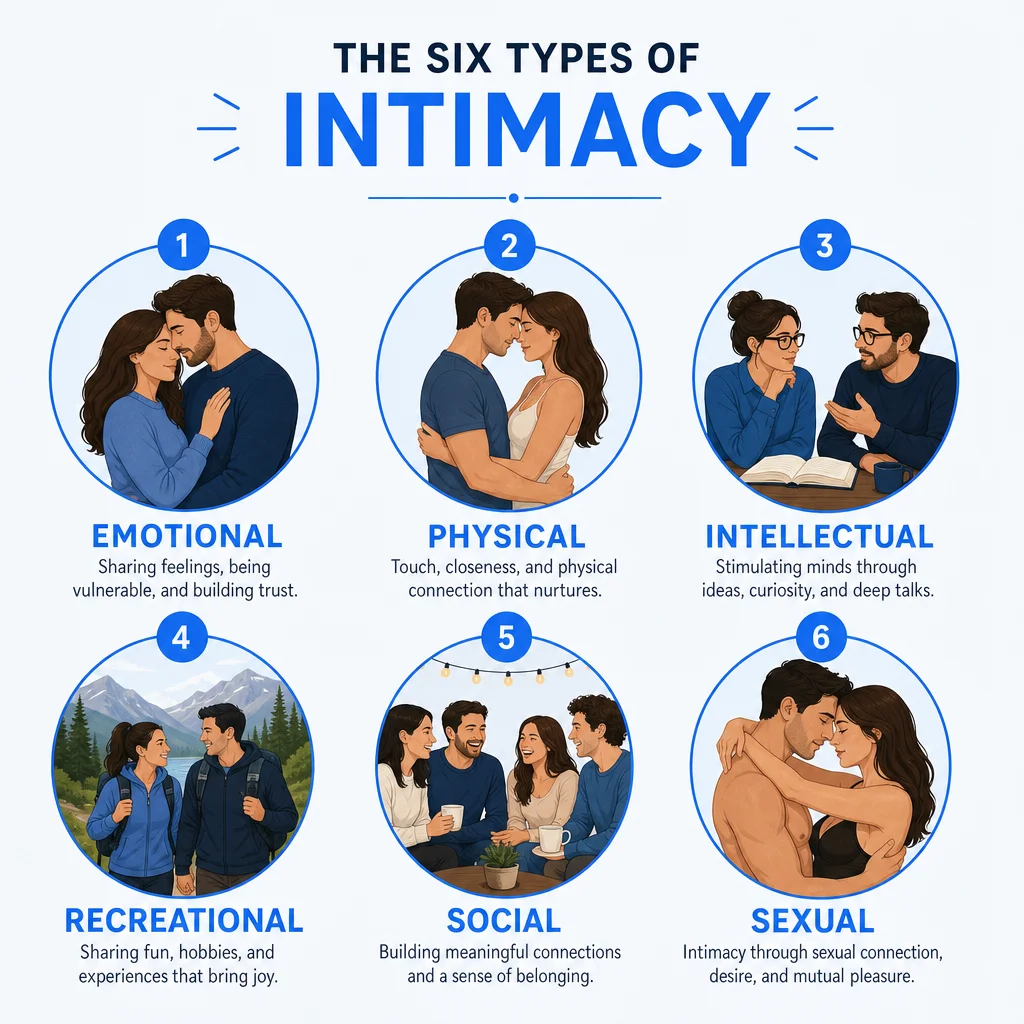
Most couples focus almost entirely on physical intimacy — and miss four other dimensions that matter just as much. Intimacy isn't just romantic; there are five essential types for fulfilling relationships. Understanding the different types of intimacy helps you spot which ones your relationship is strong in — and which ones need attention.
1. Emotional Intimacy
Emotional intimacy involves the honest sharing of your thoughts, feelings, fears, hopes, and/or dreams, and feeling heard and understood by another person. This is the foundation everything else rests on. When emotional intimacy erodes — when you stop sharing the real stuff — couples often describe feeling like roommates even while sleeping in the same bed. I've seen this pattern come up repeatedly in conversations with couples who came to Cuddle after years of surface-level connection.
2. Physical Intimacy
Physical intimacy includes physical touch — both sexual and non-sexual — such as intercourse, kissing, hugs, cuddling, sitting close together, or holding hands. Physical intimacy in a relationship is far broader than sex. Physical intimacy of course includes sex, but there is a wide spectrum of physical touch that many long-term couples forget about. It can include holding hands, cuddling, massage, a gentle kiss on the forehead, or even resting your hand on your partner's back as they pass by — subtle reminders that tell your partner "you're wanted" and "I love being close to you" without needing to say a word. These small gestures build trust and warmth and hold the connection in a relationship even when life gets busy.
3. Intellectual Intimacy
Intellectual intimacy involves communicating beliefs, viewpoints, and ideas in a way that creates intellectual stimulation, curiosity, interest, and acceptance — despite possibly differing vantage points. This is the "we actually talk about things" type of connection. Couples with strong intellectual intimacy debate ideas, challenge each other's thinking, and still feel respected at the end. It doesn't require agreeing on everything — it requires genuine curiosity about how your partner thinks.
4. Experiential Intimacy
Experiential intimacy involves doing something together that creates a shared experience or allows teamwork toward a common goal. This is why couples who travel together, cook together, or train for something together often report feeling closer — the shared experience creates a private world of inside references and memories that only the two of you hold.
5. Spiritual Intimacy
Spiritual intimacy involves sharing moments that bring you a sense of awe, wonder, or acknowledgment of something bigger than yourself. This doesn't require shared religious beliefs. It might look like watching a sunset together in silence, talking about what you both believe happens after death, or sitting together after a hard loss. Spiritual intimacy is about meaning — and couples who share it tend to feel profoundly anchored to each other.
Intimacy vs. Sex: A Crucial Difference
One of the most common misconceptions couples carry into therapy is that intimacy and sex are the same thing. They're not. Our culture frequently conflates sex with intimacy. But it is perfectly possible to have sex without intimacy. It is equally possible to have intimacy without sex. In fact, many couples who feel emotionally disconnected continue having regular sex — and still describe the relationship as hollow.
Although the two can — and for true satisfaction should — be intertwined, intimacy is something that goes beyond a physical act. True intimacy involves a level of emotional connection and trust that brings people closer. Cross-sectional, longitudinal, and experimental studies have provided empirical support for the idea that experiencing emotional intimacy plays a major role in maintaining sexual desire and partnered sexual activity in relationships of longer duration. Put differently: emotional intimacy often precedes a fulfilling physical connection — not the other way around.
From my perspective, this distinction is the single most important reframe for couples stuck in a cycle of physical distance. When partners stop asking "why aren't we having enough sex?" and start asking "why don't we feel close anymore?" — that's when real progress begins. The physical intimacy meaning couples search for is usually downstream of emotional reconnection.
No Intimacy in Marriage: What the Research Says
If you're searching for answers about no intimacy in marriage, you're not alone — and you're not broken. Sexless marriage is more common than most couples realize: 15–20% of marriages fit the technical definition. Lack of intimacy is one of the most common causes of distress and collapse among couples, negatively impacting their relationship and leading to incompatibility, stress, and psychological maladaptation. Yet the research also shows that most couples can recover — if they act.
Dr. John Gottman, a renowned relationship and marriage expert and founder of the Gottman Method, highlights that couples commonly wait an average of six years enduring unhappiness before seeking support. Six years is a long time to accumulate resentment. Whether the issue is a wife who never initiates intimacy, a husband who feels emotionally shut out, or simply two people who've grown parallel instead of together — the underlying mechanism is almost always the same: the daily rituals of connection stopped.
The largest predictor of sexless-marriage distress is silence: couples who can talk about it, schedule intimacy, and address underlying causes report dramatic improvement. According to data from the American Association of Marriage and Family Therapists, after undergoing marriage counseling, nearly 90% of clients observe a notable improvement in their emotional well-being and over 75% report experiencing enhanced satisfaction within their relationship. The numbers are genuinely hopeful — but only for couples who take action.
How to Improve Emotional Intimacy: Practical Starting Points
Knowing how to improve emotional intimacy starts with understanding that it's built in micro-moments — not grand gestures. The presence of intimacy in relationships has been linked to enhanced communication, conflict resolution, and overall relationship quality. Intimate partners are more likely to feel understood, valued, and validated by one another, leading to greater relationship satisfaction and longevity. Here's what that looks like in practice:
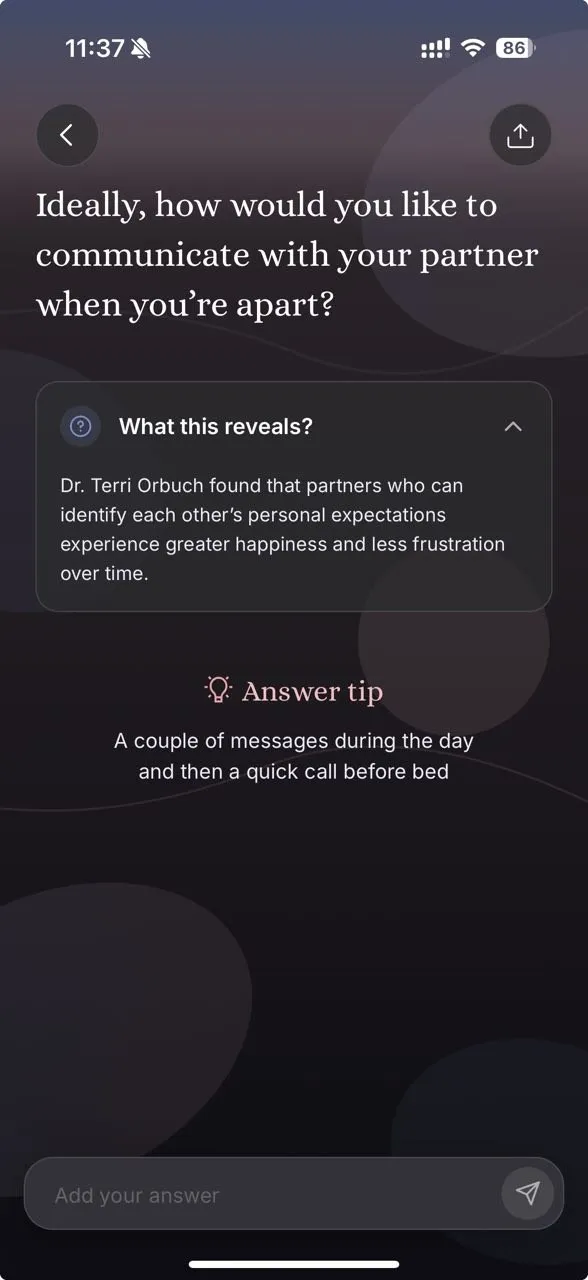
- Ask better questions. Intimacy questions for couples don't need to be dramatic. "What's been weighing on you this week?" beats "How was your day?" every time. Cuddle's Daily Questions feature does this automatically — curated questions that shift from playful to vulnerable across the week.
- Practice responsive listening. Research by psychologist Harry Reis shows that self-disclosure only creates intimacy when met with genuine responsiveness — appreciation, understanding, and acceptance. Listening to respond is not the same as listening to understand.
- Repair after conflict — don't just move on. Unresolved fights create emotional scar tissue. The Gottman Method identifies repair attempts as one of the strongest predictors of long-term relationship health. A simple "I'm sorry I said that" — said sincerely — rebuilds more intimacy than a weekend trip.
- Create physical rituals that aren't about sex. A 20-second hug in the morning. A hand on the back when passing in the kitchen. Physical intimacy in a relationship compounds through small, consistent touch — not just in the bedroom.
- Name what you need. Most intimacy breakdowns happen because partners expect their needs to be guessed. Naming a need — "I need to feel more connected to you" — is both vulnerable and actionable. It gives your partner something real to respond to.
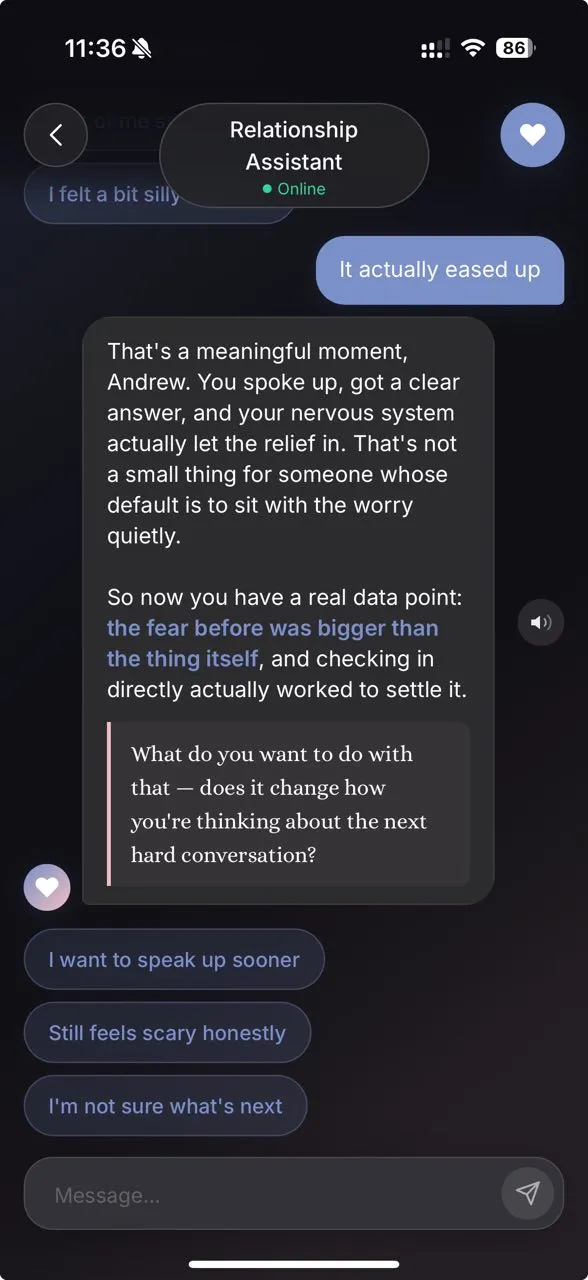
If you and your partner want a structured way to practice these skills daily, Cuddle's guided courses and Relationship Assistant offer a private, personalized coaching experience built on the same frameworks relationship therapists use — available any time, on your phone, without a $200/hour session fee.
Want a Daily Intimacy Practice That Actually Works?
Guided by Gottman Method and EFT — built for couples who want lasting change.
Intimacy Therapy and Counseling: When to Seek Help
Intimacy therapy — also called intimacy counseling or couples therapy — is the most evidence-backed intervention for couples experiencing significant disconnection. Per the Gottman Institute, 70% of couples reporting sexual problems benefit from couples therapy that addresses the broader emotional connection — not just the sexual issue. That number holds up across multiple studies and therapy modalities, including Emotionally Focused Therapy (EFT) and Cognitive Behavioral Therapy (CBT).
Couples therapy typically costs between $150 and $400 per session and is rarely covered by insurance. That's a real barrier for many couples — which is why tools like Cuddle exist in the space between doing nothing and committing to weekly professional sessions. Cuddle isn't a replacement for a licensed therapist when crises are active. But for couples who want to maintain the practices their therapist taught, or who want to start working on their relationship before problems become entrenched, it's a genuinely useful bridge.
Two other strong alternatives worth knowing: Lasting (a structured relationship health app with a CBT foundation) and OurRelationship (a free, research-backed online program developed by University of Denver researchers). Both offer structured content for couples — though neither includes a personalized Relationship Assistant that holds context across both partners the way Cuddle does. In my experience, the partner-linking feature is what separates Cuddle from generic couples apps — it's designed around the two of you as a unit, not two individuals using the same platform.
Cuddle App: Pros, Cons, and Who It's Best For
I tested Cuddle across several weeks, working through the guided courses, daily questions, and Relationship Assistant. Here's the honest breakdown:
Pros
- ✓ Built on proven frameworks — Gottman Method (94% accuracy in predicting relationship outcomes), EFT, CBT, and Attachment Theory — not generic advice
- ✓ Relationship Assistant holds context across sessions and both partners, giving personalized micro-actions instead of platitudes
- ✓ 55 guided sessions across 10 expert-built courses covering communication, conflict repair, physical intimacy, attachment, and more
- ✓ Daily Questions feature sparks genuine conversation — most couples report discovering something new about each other in the first week
- ✓ Partner-sync design means features actually work as a two-person system, not two solo users on one app
- ✓ 7-day free trial on annual plan ($59.99/year, ~58% savings vs. monthly); cancel anytime
- ✓ 4.6+ stars on the App Store; featured in Apple's 'Apps for Couples' curation
Cons
- ✗ Not a replacement for licensed couples therapy — active crises (domestic violence, addiction, severe trauma) require professional clinical support
- ✗ Best with both partners linked; some features don't fully unlock in solo mode
- ✗ Content is adult-oriented — explicit in places, which is appropriate but worth knowing upfront
- ✗ Monthly plan ($11.99/month) adds up vs. the annual option — annual is significantly better value
Final Thoughts: What Intimacy Really Means for Your Relationship
The definition of intimacy is deceptively simple — closeness, vulnerability, mutual knowing — but building it is one of the most demanding things two people can do together. Research suggests that satisfying intimate relationships contribute significantly to personal happiness and well-being, reducing feelings of loneliness and stress. True intimacy requires constant work, dedicated attention, and willingness to open up to and put trust in others. But this effort is worthwhile, because it also brings calm, joy, and the feeling of being part of something bigger than yourself.
Whether you're working through no intimacy in marriage, trying to understand the difference between intimacy vs sex, or simply looking to deepen what's already good — the path forward is the same: small, consistent investments in the relationship you actually have. That's what intimacy counseling teaches, that's what the Gottman research confirms, and that's what daily relationship tools are designed to support. The question isn't whether your relationship deserves that investment. It's whether you'll start today.
Not medical advice. Cuddle is not a replacement for licensed couples therapy or mental health treatment. Consult a qualified clinician for active relationship crises. Pricing and features subject to change — check the official site for current details.