Types of Intimacy: The 7 Forms Every Couple Should Know

Types of intimacy concept — couple sharing a quiet moment together at home

About 70% of couples who report feeling disconnected say they still love each other — they've just lost the thread. That gap usually isn't a love problem. It's an intimacy problem. Most people hear "types of intimacy" and think about sex, but physical intimacy is only one piece of a much larger picture. Researchers have identified several distinct forms of intimacy that feed a healthy relationship, and understanding all of them can change how you see your partnership entirely. If you and your partner want a structured way to start exploring these dimensions together, Cuddle offers guided daily exercises built around exactly this framework. But first — let's break down what each type actually means and why it matters.

What Is Intimacy in a Relationship?

Intimacy describes a special quality of emotional closeness between two people. It involves mutual caring, trust, open communication of feelings, and an ongoing exchange of meaningful experiences. Self-disclosure — the willingness to share your inner world — is one of its most critical ingredients.

Why Different Types of Intimacy All Matter

Here's something I've noticed after years of studying relationship research: couples rarely fall apart because one big thing broke. They drift because small forms of closeness quietly erode — the intellectual conversations stop, the non-sexual touch disappears, the spiritual alignment goes unspoken. Research confirms this pattern. A 2019 study found that intimacy serves as "a fundamental component of healthy relationships and promotes mental and physical health." That's not a soft claim — it's a measurable outcome.

The good news is that intimacy is learnable. The more forms of intimacy you share with a partner, the closer you tend to feel overall. A relationship doesn't need every single type to thrive, but most flourishing partnerships have cultivated several of them deliberately. Think of it less like a checklist and more like a garden — different plants need different kinds of attention, and neglecting one section long enough will eventually affect the whole.

The 7 Forms of Intimacy Every Couple Should Understand

Psychologists and relationship therapists have mapped intimacy across several dimensions. The seven forms below draw from multiple frameworks — including Robert Sternberg's Triangular Theory of Love, the Gottman Method, and Emotionally Focused Therapy (EFT) — and represent the most research-supported categories for couples in long-term relationships.

1. Emotional Intimacy

Emotional intimacy is the foundation most other forms rest on. It builds through self-disclosure and responsive communication — the cycle of one partner sharing something vulnerable and the other responding with empathy rather than dismissal. Research shows that emotional intimacy produces feelings of reciprocal trust, validation, and closeness between individuals. When it's missing, partners often describe feeling like roommates: physically present, emotionally elsewhere.

A famous study by psychologist Arthur Aron demonstrated this powerfully: researchers had strangers ask each other increasingly personal questions, and many developed genuine romantic feelings within 45 minutes. The study showed that romantic attraction blooms when people take turns revealing their inner emotional world and listening to each other. You don't need a lab to replicate this — you need consistent, intentional conversation. Therapists often recommend setting aside 20-30 minutes per week specifically for emotional check-ins, without phones or problem-solving agendas.

2. Physical Intimacy

Physical intimacy is what most people picture first — and it's genuinely important. But physical intimacy in a relationship extends well beyond sex. It includes hugging, kissing, holding hands, cuddling on the couch, and any form of non-sexual touch that communicates care and presence. Research confirms that physical touch correlates with relationship satisfaction and feelings of love. The key distinction here is separating physical affection from sexual expectation.

When couples only engage in physical affection immediately before or during sex, they risk turning the experience into one that feels transactional and devoid of pleasure. Physical intimacy meaning, at its deepest level, is about communicating "I see you and I'm here" through touch — not just initiating a sequence. In my experience, couples who rebuild non-sexual touch first often report that sexual connection improves naturally as a result. The body reads safety before it reads desire.

Couple sharing a quiet moment outdoors, physical closeness and connection

3. Intellectual Intimacy

Intellectual intimacy — sometimes called mental intimacy — happens when partners feel genuinely curious about each other's minds. It's having a healthy curiosity and learning from each other: sharing opinions, debating ideas, and feeling safe to hold a different view without the conversation becoming a competition. Intellectual intimacy builds respect and admiration, which are two of the most underrated ingredients in long-term attraction.

You don't need to share identical politics or read the same books. The goal isn't agreement — it's mutual respect and genuine interest. Intellectual intimacy can be as simple as asking your partner what they think about something they care about and actually listening to the answer. Some people are what researchers call sapiosexual, meaning intellectual connection is their primary driver of attraction. Even if that's not you, most couples report that stimulating conversation keeps the relationship feeling alive rather than routine.

4. Spiritual Intimacy

Spiritual intimacy doesn't require shared religion. It means being able to discuss the deeper meaning of life — your values, your sense of purpose, what you believe happens when things get hard. Spiritual intimacy is the degree to which you and your partner share your thoughts, feelings, beliefs, and experiences about life's bigger questions. Partners don't need identical answers. They need to feel safe asking the questions together.

In practice, spiritual intimacy often shows up in conversations about how you want to raise children, what you prioritize in a career, how you process grief, and what gives your life meaning. Couples who build this form of closeness tend to weather life transitions better — because they've already established a shared framework for navigating uncertainty. Research on spiritual intimacy and marital satisfaction consistently finds it acts as a buffer during high-stress periods.

5. Experiential Intimacy

Experiential intimacy is what you build when you do things together. It's not complicated — it's the shared memory bank that makes a relationship feel like a life rather than a cohabitation arrangement. Experiential intimacy happens when you reach out to spend time with someone while doing something you both enjoy on an emotional, physical, or mental level. New experiences accelerate this: novelty triggers the same dopamine pathways as early-stage attraction, which is why couples who try new activities together often report feeling "re-sparked."

From my perspective, this is the type of intimacy most couples let slip first — not because they stop caring, but because life fills the calendar. Date nights get cancelled. Shared hobbies get crowded out by work and kids. The fix isn't a grand gesture; it's a recurring small one. A 30-minute walk, a cooking experiment, a board game on a Tuesday. Consistency beats intensity every time.

6. Creative Intimacy

Creative intimacy involves planning and creating things together. It goes beyond taking an art class — it includes designing your future together, setting shared goals, building something neither of you could build alone. Research on the Gottman Method notes that couples who maintain a shared vision for their future demonstrate higher relationship resilience. Creative intimacy is how that vision gets built: through conversation, imagination, and collaborative problem-solving.

This form of intimacy often overlaps with intellectual and experiential closeness, but it has a distinct forward-looking quality. It's less about what you've done and more about what you're building. Couples who talk about future plans — even small ones, like a trip they want to take or a home project they want to tackle — signal commitment and shared investment. Future-oriented intimacy is so potent that researchers note it can even be used as a manipulation tactic when one partner pretends to be more excited about their future than they truly are.

7. Conflict Intimacy

Conflict intimacy is the most counterintuitive entry on this list, but it might be the most important one. It's the ability to disagree, repair, and remain committed — to make mistakes and still choose each other. Conflict intimacy allows you to make mistakes but remain committed as a couple. Gottman's research found that approximately 70% of the conflicts couples have are irreconcilable differences — meaning the goal isn't resolution, it's respectful management.

Couples who develop conflict intimacy don't avoid hard conversations. They learn how to have them without contempt, criticism, or stonewalling. They develop what Gottman calls "repair attempts" — the small bids to de-escalate tension before it becomes damage. I believe this is the form of intimacy that separates couples who stay close for decades from those who gradually become strangers. It's not about fighting less. It's about fighting in a way that leaves both people feeling heard rather than defeated.

Cuddle Editorial team — diverse adults discussing relationship research together

How to Identify Which Types of Intimacy Your Relationship Needs

Relationships vary in the extent to which they demonstrate each intimacy type — and that's completely normal. The goal isn't to score equally across all seven. It's to notice where the gaps are and make deliberate choices about them. A good starting strategy is to identify the areas of intimacy where you aren't as strong so that you can foster more closeness within them.

Here's a practical approach I've found useful: each partner independently rates the seven types on a 1-5 scale, then compares notes. The conversation that follows — not the scores themselves — is where the real intimacy happens. You'll likely discover that you've been prioritizing different things without realizing it. That insight alone can shift the dynamic. Intimacy questions for couples work especially well here because they create structure without pressure.

If you want a guided version of this process, apps like Cuddle offer structured daily questions and quizzes — including attachment style and intimacy preference assessments — that help couples surface these gaps without it feeling like homework. Tools like the Gottman Card Decks (available free online) and books like Hold Me Tight by Dr. Sue Johnson (the foundational EFT text) are also strong starting points for couples who prefer a more self-directed approach.

Intimacy vs. Sex: An Important Distinction

One of the most common misconceptions couples bring into therapy is conflating intimacy with sex. Intimacy vs sex is a distinction worth understanding clearly: sex can be intimate, but intimacy is not synonymous with sex. Researchers have found that in the context of sex, intimacy consists of two core elements — self-disclosure and empathy. Partners need to feel comfortable enough with each other to tolerate the vulnerability that comes with being honest about their wants, needs, and desires.

This matters practically because couples experiencing no intimacy in marriage often focus exclusively on the sexual dimension while the emotional, intellectual, and experiential layers have quietly collapsed. Rebuilding sexual connection without addressing those other layers tends to produce short-term results at best. The experience of emotional intimacy plays a particularly large role in maintaining sexual desire and partnered sexual activity in relationships of longer duration — especially for women, whose sexual desire research shows is more likely to emerge once they feel emotionally intimate with their partner.

Two coffee mugs on a wooden table in warm morning light — cozy couple connection

How to Improve Emotional Intimacy: Practical Starting Points

Emotional intimacy is the most frequently neglected area in long-term relationships — and also the one most responsive to small, consistent effort. To build emotional intimacy with your partner, dedicate time to each other every week. Be intentional about vulnerability during this time, give encouragement and validation, and let them know you're absorbing what they're saying. Consistency builds trust, and trust is the precondition for everything else.

One note worth making: if emotional intimacy has been absent for a long time, rebuilding it can feel awkward at first. That discomfort is normal — it doesn't mean something is wrong. It means you're exercising a muscle that hasn't been used in a while. For couples dealing with significant ruptures or long-term emotional distance, intimacy counseling with a licensed therapist who specializes in Emotionally Focused Therapy can accelerate the process considerably. EFT has one of the strongest evidence bases in couples therapy, with research showing 70-75% of couples moving from distress to recovery.

When to Consider Intimacy Therapy

Intimacy therapy — whether through EFT, the Gottman Method, or CBT-based couples counseling — is worth considering when self-directed efforts plateau. Signs it's time: recurring conflicts that don't resolve, emotional shutdown, significant changes in physical connection, or one partner feeling consistently unseen. A licensed therapist provides a structured, safe environment that most couples can't replicate on their own.

Different Types of Intimacy Across Relationship Stages

The different types of intimacy don't stay static across a relationship's lifespan — they shift in priority and expression as the relationship matures. Early-stage couples often lead with physical and experiential intimacy: the excitement of shared firsts, physical attraction, and novelty. Over time, passionate love often fades, leaving what researchers call companionate love — the stuff of commitment and emotional intimacy. Partners who feel this form of love essentially regard each other as best friends.

This transition isn't a failure. It's a natural developmental shift. The couples who navigate it well are those who consciously invest in emotional, intellectual, and spiritual intimacy as the initial rush of passion levels out. They don't mistake the quieter connection of companionate love for distance — they recognize it as a different, deeper kind of closeness. Couples who struggle with this transition often benefit from reframing: the goal isn't to recreate year one. It's to build something year one couldn't have.

Long-distance couples face a particular challenge here: physical intimacy becomes logistically constrained, which puts extra demand on emotional, intellectual, and creative forms. In my experience, long-distance partners who deliberately cultivate non-physical intimacy — through intentional conversation, shared goals, and async connection rituals — often develop stronger emotional bonds than co-located couples who default to physical proximity as a substitute for genuine closeness.

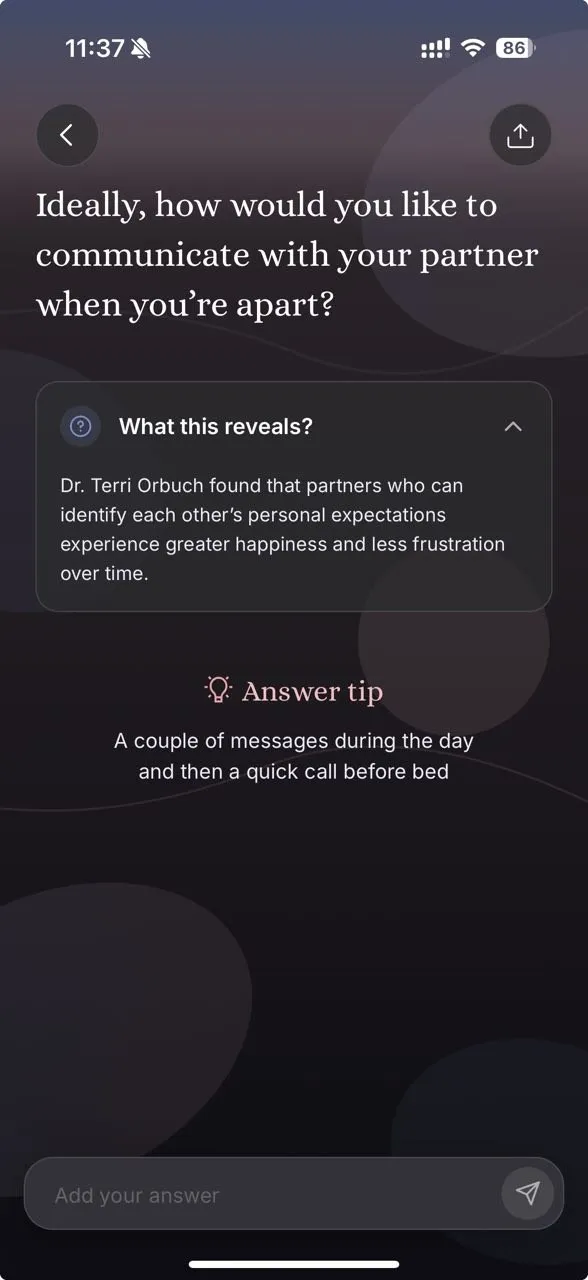
Cuddle Daily Questions feature — partners answering and comparing responses on iPhone

Tools like Cuddle's Daily Questions feature — where partners answer separately and then compare responses — are specifically designed for this kind of intentional, async connection. It's one practical example of how structure can compensate for the entropy that naturally creeps into long-term relationships. Other options include couples journals, therapy-based workbooks like Eight Dates by John and Julie Gottman, or regular relationship check-ins modeled on the Gottman "State of the Union" conversation format.

Disclosure: This page contains affiliate links. We may earn a commission at no extra cost to you.

Want to Explore All 7 Types Together?

Structured daily exercises for couples, built on Gottman Method and EFT frameworks.

Try Cuddle Free for 7 Days

Frequently Asked Questions

What are the main types of intimacy in a relationship?
Researchers and therapists identify several core forms of intimacy, most commonly including emotional, physical, intellectual, spiritual, experiential, creative, and conflict intimacy. Emotional intimacy — the ability to share your inner world and feel genuinely heard — is generally considered the foundation. Physical intimacy covers both sexual and non-sexual touch. The other types build on these two by adding intellectual curiosity, shared values, shared experiences, collaborative vision, and the ability to repair after conflict.
What is the difference between intimacy and sex?
Intimacy and sex are related but distinct. Sex can be an expression of intimacy, but intimacy itself is a broader concept involving closeness, trust, vulnerability, and self-disclosure across multiple dimensions. Researchers define intimacy as a sense of closeness that transcends physical contact and may bring emotional, mental, and spiritual understanding to a relationship. Many couples experience high sexual frequency with low emotional intimacy — or strong emotional connection with reduced sexual activity. Both patterns point to an imbalance worth addressing.
How do I improve emotional intimacy with my partner?
Start with consistency over intensity. Set aside dedicated time each week for conversation without an agenda — no problem-solving, no phones. Practice naming emotions specifically rather than defaulting to "fine" or "stressed." Respond to your partner's bids for connection, even small ones. Share something you've been privately carrying. If self-directed efforts plateau, Emotionally Focused Therapy (EFT) with a licensed couples therapist has one of the strongest evidence bases in the field, with research showing 70-75% of couples moving from distress to recovery.
What happens when there's no intimacy in a marriage?
When intimacy erodes — across any of its forms — couples often describe feeling like roommates: physically present but emotionally distant. Research shows that satisfying intimate relationships contribute significantly to personal happiness and well-being, reducing feelings of loneliness and stress. The absence of intimacy rarely signals a sudden crisis; it's usually a gradual drift. Couples who catch it early and address it deliberately — through intentional conversation, shared experiences, or couples counseling — tend to recover more fully than those who wait until the distance feels insurmountable.
Can you have intimacy without physical contact?
Absolutely. While physical intimacy is one important dimension, intimacy is fundamentally about emotional connection and understanding. Long-distance couples, couples navigating illness or disability, and couples in different life stages regularly maintain deep intimacy through emotional, intellectual, spiritual, and creative connection. Research confirms that intimate relationships are not necessarily sexual, and physical contact is not a requirement for a relationship to be genuinely intimate.
What is intellectual intimacy and how do you build it?
Intellectual intimacy — also called mental intimacy — is the closeness that comes from genuine curiosity about your partner's mind. It involves sharing opinions, debating ideas, and feeling safe to hold different views without the conversation becoming a power struggle. You build it by staying curious: ask about their perspective on things they care about, share what you're learning, and approach disagreements as opportunities to understand rather than to win. Mutual respect is the key ingredient — not agreement.
Is intimacy counseling worth it?
For many couples, yes — especially when self-directed efforts haven't produced lasting change. Intimacy counseling, whether through Emotionally Focused Therapy, the Gottman Method, or CBT-based couples therapy, provides a structured environment that's difficult to replicate independently. A trained therapist can identify patterns couples can't see from inside the relationship, offer repair tools calibrated to the specific dynamic, and hold both partners accountable to the process. It's worth considering when recurring conflicts don't resolve, emotional shutdown is present, or one partner consistently feels unseen.
What are good intimacy questions for couples?
The best intimacy questions move past surface-level small talk into genuine self-disclosure. Examples include: "What's something you've wanted to tell me but haven't found the right moment for?" / "What do you need more of from me right now?" / "What's a fear you've been carrying that I don't know about?" / "What's something you're proud of that I might not have noticed?" Structured tools — like the Gottman Card Decks, the 36 Questions study, or apps with curated daily questions — can make this kind of conversation easier to initiate consistently.