
What Is Intimacy? Meaning, Definition & Why It Matters

Nearly 40–50% of marriages in the United States end in divorce, according to the American Psychological Association. Research consistently points to a breakdown in intimacy as one of the leading drivers. Yet for something so central to human connection, the intimacy definition remains surprisingly misunderstood. Most people equate it with sex. In reality, what is intimacy covers a much wider terrain. It includes emotional closeness, intellectual connection, shared experience, and the quiet trust that lets two people truly be seen. This guide unpacks the full meaning of intimacy, explores its different types, and shows you what the science says about building it — or rebuilding it when it fades. If you want a structured daily practice to support that work, Cuddle is one option worth exploring.
Intimacy Definition: What It Really Means
Intimacy is a sense of closeness and connection that goes beyond physical contact. It brings emotional, mental, and sometimes spiritual understanding to a relationship. Psychologist Harry Reis and colleagues describe it as a process where self-disclosure must occur within a context of appreciation, affection, understanding, and acceptance. In other words, intimacy isn't just about sharing your inner world. It also requires your partner to respond to that sharing with genuine empathy and care.
The intimacy meaning also involves reciprocity. Research from EBSCO's psychology database notes that intimacy refers not just to the act of self-disclosure but also to the interpersonal interaction in which that disclosure is validated and reciprocated. You open up, your partner responds, and then they open up in turn. This back-and-forth cycle is what transforms a surface-level relationship into something genuinely close. When that cycle breaks down — when one partner stops disclosing, or the other stops responding with warmth — the intimacy definition in action starts to erode.
The 5 Types of Intimacy in a Relationship
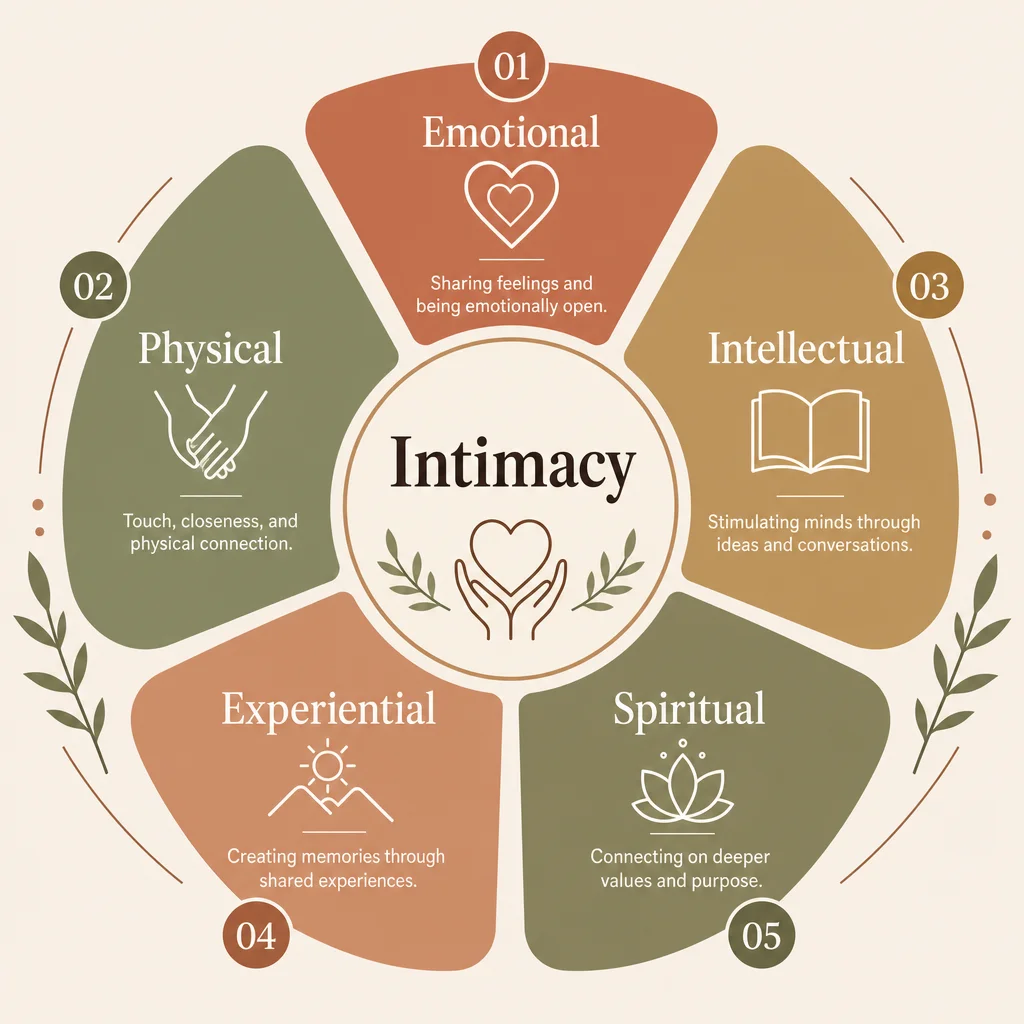
Understanding the different types of intimacy matters because couples often feel disconnected in one area while thriving in another. I've noticed in conversations with couples that partners frequently mistake the absence of physical intimacy for a total breakdown in connection. The real gap is often emotional or intellectual. Recognizing all five forms gives you a clearer map of where your relationship actually stands.
- Emotional intimacy — The honest sharing of thoughts, feelings, fears, hopes, and dreams, paired with feeling genuinely heard. It's most closely tied to long-term relationship satisfaction, and it's the form couples tend to lose first when life gets busy.
- Physical intimacy — All forms of physical touch: sex, but also hugging, holding hands, cuddling on the couch, and sitting close together. Research shows that affectionate non-sexual touch powerfully conveys positive feelings toward a romantic partner. Couples who limit touch to moments just before sex risk making the experience feel transactional.
- Intellectual intimacy — A connection that grows when partners share beliefs, viewpoints, and ideas in a way that creates curiosity and mutual respect, even when they disagree.
- Experiential intimacy — Closeness that forms through shared activities, such as training for a race together, cooking a new recipe, or volunteering for a cause you both care about.
- Spiritual intimacy — A bond built around shared values, meaning, and a sense of something larger than yourselves. It doesn't require shared religion. A 2016 study cited by PsychCentral identified spiritual intimacy as a key predictor of marital success, which surprises many couples who assume it's the least important of the five.
Intimacy vs Sex: Why the Distinction Matters
The conflation of intimacy vs sex causes real harm in relationships. When a partner says "we have no intimacy," they often mean they feel emotionally distant. Yet the other partner hears a complaint about their sex life and responds defensively. Researchers have found that in the context of sex, intimacy consists of two core elements: self-disclosure and empathy. Partners need to feel comfortable enough to be honest about their wants, needs, and desires. They also must trust that their partner will respond with openness rather than ridicule or rejection.
Emotional intimacy can exist without physical intimacy — this happens in many deep friendships. Conversely, sex can occur with very little emotional intimacy, leaving both partners feeling hollow afterward. The most satisfying long-term relationships tend to cultivate both. But couples navigating a mismatch — like the common experience of "my wife never initiates intimacy" or a partner feeling emotionally shut out — often need to address the emotional layer first. Physical closeness usually follows naturally once emotional safety is restored. In my experience, couples who try to fix the physical intimacy gap without repairing emotional safety rarely sustain the change.
Why Intimacy Fades — and What the Research Says
Gottman's decades of research at the University of Washington's "Love Lab" revealed that 69% of relationship conflicts are perpetual. They never fully resolve, because they're rooted in personality differences rather than solvable problems. What separates thriving couples from struggling ones isn't the absence of conflict. It's how they maintain connection around that conflict. Happy couples turn toward each other's bids for emotional connection far more often than couples in distress. These small moments — a hand on the shoulder after a hard day, a genuine question about your partner's stress — are the micro-deposits that build intimacy over time.

Intimacy also fades when stress and overcommitment crowd out the space for connection. A busy lifestyle leaves little room for nurturing relationships. When both partners are depleted, the first thing to go is the quality of attention they give each other. Attachment patterns formed in childhood add another layer. Those with insecure attachment may struggle with trust or fear of abandonment, making it genuinely harder to stay open even when they want to. Understanding why intimacy fades in your specific relationship is the starting point for rebuilding it.
How to Improve Emotional Intimacy: Practical Steps
The good news is that intimacy isn't a fixed trait — it's a skill couples can build with consistent, intentional practice. Research on how to improve emotional intimacy points to a few high-leverage behaviors. First, ask better questions. Most couples talk about logistics — schedules, bills, the kids — without ever asking about each other's inner experience. Intimacy questions for couples, like "What's something you've been carrying lately that you haven't told me?" or "What would you most want me to understand about how you're feeling right now?", open doors that small talk keeps shut. One question I keep returning to with couples is simply, "What did today feel like for you?" — it's brief, it's open, and it bypasses the logistics trap almost every time. I believe this single shift — moving from transactional talk to curious, vulnerable conversation — accounts for more intimacy growth than almost any other change.
Second, respond to bids for connection. Gottman's research identifies "turning toward" as one of the most powerful predictors of relationship health. When your partner makes a bid — a comment, a touch, a look — turning toward it (even briefly) builds the emotional bank account that sustains intimacy through hard times. Third, make physical affection non-sexual. Couples who touch each other affectionately outside of sexual contexts report significantly higher satisfaction with physical intimacy in relationship overall. A morning hug, a hand held during a walk, a back rub with no agenda — these acts signal safety and warmth, which is the soil intimacy grows in.
For couples who want a structured approach to these practices, apps like Cuddle offer guided daily exercises built on the Gottman Method, Emotionally Focused Therapy (EFT), and Attachment Theory — covering communication, conflict repair, and both emotional and physical intimacy in relationship. Alternatively, working directly with a licensed couples therapist trained in EFT or the Gottman Method remains the gold standard for deeper repair work. This is especially true when no intimacy in marriage has persisted for a long time or when trust has been significantly damaged.
When to Seek Intimacy Therapy or Counseling
Some intimacy challenges respond well to self-directed practice. Others require professional support. Intimacy therapy — sometimes called intimacy counseling — is worth considering when emotional disconnection has persisted for six months or more, when one partner feels consistently unseen or unheard, when a specific event (an affair, a loss, a major life transition) has created a rupture that daily effort hasn't healed, or when one partner has shut down entirely. From my perspective working with couples, the pattern I see most often before people finally book a therapist is months of one partner trying to "fix it alone" — and that solo effort almost never lands, because intimacy is fundamentally a two-person system. The Fear of Intimacy Scale (FIS), used by therapists to assess intimacy avoidance, links high scores to increased loneliness and depression — signs that the issue has moved beyond relationship dynamics into individual mental health territory.
Gottman Method couples therapy and Emotionally Focused Therapy are the two most research-supported frameworks for intimacy counseling. A published study in the Iranian Journal of Psychiatry found that Gottman couple therapy had statistically significant positive effects on both marital adjustment and couples' intimacy. Those effects held up in follow-up assessments. EFT, developed by Dr. Sue Johnson, focuses on identifying and changing negative interaction patterns while promoting secure attachment bonds. It's particularly effective for couples where attachment wounds are driving the disconnection. Both approaches are available through licensed therapists, and many now offer sessions online.

Intimacy and Physical Health: The Connection You Didn't Expect
The stakes of intimacy extend well beyond relationship satisfaction. Research has shown that the availability and quality of intimacy are associated with well-being for both men and women. Studies found that men who reported a lack of emotional support from their wives were significantly more likely to experience heart attacks. That's a striking data point. It frames intimacy not as a luxury but as a health variable. Satisfying intimate relationships contribute meaningfully to personal happiness and well-being, reducing feelings of loneliness and stress. Conversely, when a person repeatedly fails to share their inner world with even one trusted person, they risk emotional isolation. That state is linked to depression, anxiety, and reduced immune function.
This is why the question "why doesn't my husband love me anymore?" or "my wife never initiates intimacy" carries so much weight. These aren't just complaints about a relationship. They're signals that something essential to human health is missing. From my perspective, the most important reframe couples can make is to stop treating intimacy as a reward for a good relationship. Start treating it as a practice that creates one. Small, consistent daily investments — the kind that compound into lasting change — matter far more than grand gestures made once a year.
The different types of intimacy don't all need to be strong at once. Research suggests that identifying the area where you and your partner are weakest — then targeting that specific form — is a more effective strategy than trying to improve everything simultaneously. Is it emotional distance after a conflict? Intellectual disconnection because you've stopped sharing ideas? Physical intimacy in relationship that's become routine or absent? Name it specifically, and you've already taken the first step toward rebuilding it.
Ready to Build Deeper Intimacy Together?
Daily guided exercises for couples, built on the Gottman Method and EFT — five minutes a day.
Try Cuddle Free for 7 DaysDisclosure: This page contains affiliate links. We may earn a commission at no extra cost to you.