
Sexless Marriage: Causes, Effects & How to Reconnect
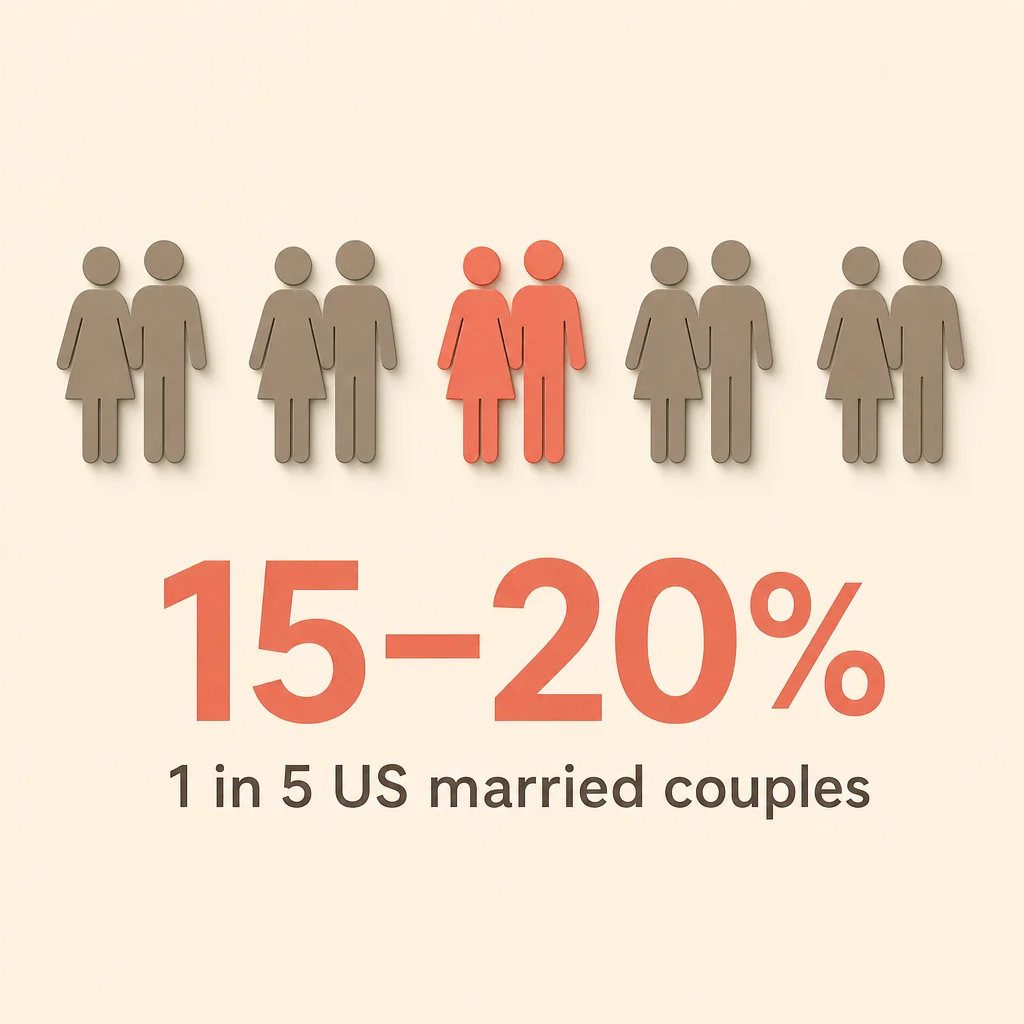
Around 15–20% of married couples in the US qualify as being in a sexless marriage — defined as having sex fewer than 10 times per year, according to the Indiana University National Survey of Sexual Health and Behavior. That's roughly one in five couples. If you're searching "we never have sex anymore" or wondering why your sex life has decreased, you're far from alone. The good news: a sexless marriage isn't a verdict. It's a signal. And understanding what's actually driving the distance — emotional, physical, or relational — is the first step toward closing it. If you're looking for a structured daily way to start rebuilding closeness, Cuddle is one option couples use between therapy sessions or on their own.

What Actually Defines a Sexless Marriage
Sex therapists and researchers most commonly define a sexless marriage as one where partners have sex fewer than 10 times per year. The International Society for Sexual Medicine adds an important nuance: there's no universally "normal" frequency — what matters is whether both partners feel satisfied. A couple having sex twice a month and feeling great about it isn't sexless in any meaningful sense. The problem arises when there's a gap between what one or both partners want and what's actually happening. That gap — the lack of intimacy in marriage — is what creates the emotional pain most people describe.
It's also worth separating sex frequency from physical intimacy more broadly. Couples in a sexless marriage often stop touching, kissing, and even making eye contact in the ways they once did. The absence of sex is usually a symptom of a wider withdrawal — not the root cause itself. That distinction matters enormously for how you approach reconnection.
Why Has Our Sex Life Disappeared? The Most Common Causes
Couples often ask why their sex life has decreased or stalled entirely — and the answers usually cluster around a small set of drivers. Mismatched libido is the single most cited cause of marriage without intimacy. It appears in roughly 67% of sexless-marriage cases according to a Kinsey Institute 2024 review. But libido mismatch rarely exists in a vacuum. It's almost always tangled up with other factors. Work exhaustion plays a primary role in 48% of dual-income sexless couples (Harvard Business Review). Childcare demands contribute to 55% of cases involving young children (APA). Medical conditions — low testosterone, SSRI side effects, postpartum hormonal shifts — resolve the problem in roughly 50% of cases when treated directly (American Journal of Sexual Medicine, 2024).
Emotional disconnection is perhaps the most underestimated cause. Research associated with therapist Esther Perel's work identifies lack of emotional intimacy as the primary cause in 61% of cases. Relationship therapists consistently observe that when couples stop having sex, it usually reflects a lack of emotional intimacy rather than a lack of physical desire. The sequence tends to run: unresolved conflict leads to emotional withdrawal. Emotional withdrawal leads to physical withdrawal. Both partners end up feeling rejected and confused about why their sex life has disappeared.
The Emotional Effects of No Intimacy in Marriage
Living with no intimacy in marriage carries a real psychological cost. A study published in JAMA Internal Medicine found that those in sexless marriages report significantly lower relationship satisfaction and increased symptoms of depression. Depression itself appears in 40% of sexless-marriage partners (NIMH). Beyond clinical measures, couples describe a specific kind of loneliness. They share a home, a bed, and a life with someone who feels increasingly like a stranger. That loneliness compounds over time. One partner pulls back emotionally to protect themselves from rejection. The other interprets the withdrawal as confirmation they're unwanted. The cycle deepens.
The effects aren't symmetrical between partners, either. In roughly 70% of cases where one partner initiates withdrawal from sexual activity, it tends to be the woman pulling back first. The reasons are usually emotional disconnection, stress, hormonal shifts, or body-image concerns — not vanished desire. Men frequently experience this withdrawal as rejection. That rejection triggers their own emotional shutdown. Understanding this dynamic — rather than assigning blame — is what breaks the cycle.
How to Reconnect: Evidence-Based Steps That Actually Work

The Gottman Institute's research finds that 70% of couples with sexual problems benefit from couples therapy that addresses the broader emotional connection — not just the sexual issue itself. That finding points to the most important principle in reconnecting: don't start with sex. Start with emotional safety. Reversing a sexless marriage almost always requires rebuilding emotional intimacy first, before physical intimacy can follow. More emotional closeness leads to more physical desire — but the reverse isn't reliably true.
In practice, that means creating low-stakes moments of connection before attempting conversations about sex directly. Small physical touches — a hand on the shoulder, sitting closer on the couch — rebuild comfort without pressure. University of British Columbia researcher Dr. Lori Brotto's work shows that couples who schedule intentional intimacy (not necessarily sex, but closeness) report higher satisfaction than couples who wait for spontaneous desire to return. Desire, it turns out, often follows action rather than preceding it. If you want a structured way to build those daily rituals together, Cuddle's guided courses on sex and physical intimacy offer a research-backed starting point for couples navigating desire mismatch.
When to Seek Professional Help for a Sexless Marriage
Some patterns of disconnection run too deep for self-guided work alone. If conversations about your sex life consistently lead to defensiveness, avoidance, or escalating conflict, a licensed couples therapist or certified sex therapist can help mediate those discussions and identify the emotional roadblocks underneath. Sex therapy is talk therapy — no physical contact is involved — and it provides a neutral space to address desire mismatch, communication breakdowns, and trust issues. The American Association of Sexuality Educators, Counselors and Therapists (AASECT) maintains a directory of certified sex therapists if you're looking for a specialist.
Marriage counseling using the Gottman Method or Emotionally Focused Therapy (EFT) has strong empirical backing for rebuilding emotional intimacy — which, as the research shows, is typically the precondition for physical reconnection. Apps like Lasting offer structured self-guided exercises between therapy sessions. For couples who aren't ready for therapy but want a more guided approach than reading articles, daily structured check-ins and intimacy-focused exercises can serve as a productive middle step.
Practical Daily Habits That Help Couples Rebuild Intimacy

Reconnection doesn't require grand gestures. In my experience reviewing relationship research and couples' accounts, the couples who successfully move out of a sexless marriage share a few consistent habits: they talk about their relationship regularly (not just when there's a crisis), they maintain small physical affections even when desire is low, and they approach the issue as a shared problem rather than one partner's failing. The goal isn't to force frequency — it's to rebuild the emotional safety that makes desire possible again.
- Schedule a weekly 20-minute check-in to talk about the relationship — not logistics, but feelings and needs
- Reintroduce non-sexual physical touch: hugs, hand-holding, sitting close — without any expectation of escalation
- Use intimacy questions for couples to spark honest, low-pressure conversations about desire and connection
- Address underlying medical factors (hormones, medications, sleep) with a healthcare provider
- Try structured daily rituals — even five minutes — to stay emotionally present with each other
- Seek couples therapy or sex therapy if self-guided attempts consistently stall or escalate into conflict
A sexless marriage is rarely irreversible. What makes the difference is whether both partners are willing to treat it as a shared challenge rather than a personal indictment — and whether they take consistent, small steps toward closeness rather than waiting for the problem to resolve on its own. The research is clear: couples who pay attention to the signal and act on it can recover.
Disclosure: This page contains affiliate links. We may earn a commission at no extra cost to you.
Related Articles


Want to Start Rebuilding Closeness Today?
Cuddle offers guided intimacy courses and daily connection rituals — built on Gottman Method and EFT research.
Explore Cuddle Free for 7 Days